Scarcity versus abundance in scholarship.
By MARLENE L. DAUT
A recent piece I published over in Lapham's Quarterly about the 19th-century Haitian artist Lafargue (not Louis!) Rigaud called “On the Artist (Formerly) Known as Louis Rigaud,” has me thinking a lot about approaches to research. I try to approach my research with an abundance mentality, but I have noticed a spreading trend of approaching research with a scarcity mentality.
I think in Haitian Studies a scarcity mentality would be extremely harmful, especially, if it leads scholars to not even look for certain kinds of information and instead to just assume that whatever answers there might be to pressing biographical questions, to take one example, have long been lost to the elements or to time itself.
Today’s scholars of Haiti know that if you know where to look, there's an abundance, a wealth even, of materials that have been preserved and that are now exceedingly accessible—thanks, in grand part, to digitization projects like the Digital Library of the Caribbean (DLOC), the British Library’s Endangered Archives Program, the Bibliothèque Nationale de France’s Gallica, and Manioc.org, among many others.
Nothing can really replace visits to physical archives (especially those in Haiti), but even just starting with the online resources, if you have both the time and the inclination, you can find all kinds of answers to historical questions instead of simply leaping to speculative or imaginative approaches. This is not to say that there isn't loss or ongoing threats to Haitian archives—because there definitely is—or that there is anything wrong with speculative approaches—because there definitely is not—but I do think that in many subfields I sometimes see too much focus on what is lost or what might never be known simply because it was not ever recorded.
What is lost or unrecorded is not something that only affects those of us who study slavery, the pre-20th-century Caribbean, and other marginalized nations, societies, and individuals. An article sent to me by my colleague and co-curator, Mark Aronson, “Notes on the Survival of Thirteenth-Century Panel Paintings in Italy,” by Edward B. Garrison, has me thinking about how loss, in the context of art, specifically, is a feature of most societies. Garrison writes:
"In a recent study, I made the statement that a very high percentage of the paintings originally produced in Italy in such remote periods as the twelfth and thirteenth centuries must be considered lost, and that although there is no scientific basis for calculating the losses, an informed estimate of 70 to 80% is not, especially if manuscript illustrations are taken into account, too high. My purpose in making this statement was to drive home the fact that a purely inductive method of art history cannot possibly yield satisfactory historical syntheses, and that it must be complemented—indeed preceded—by a total cultural apparatus from which deductions can be made."
Garrison further clarified by using the example of thirteenth-century panel paintings in Italy: “Of course, it is impossible to estimate the number actually produced in the country in this period. But if we suppose that the loss is only 80%, then only 40 panels can have been produced each year. Few will want to deny, I think, that such a production-figure must be absurdly low.”
While these panels constituted wall art that evidently few thought to preserve at the time, Garrison highlights how deductive evidence points to their proliferative nature anyway: “One need only recall the great number of painters registered in the principal city-states in the thirteenth century, or the evidence that, for example in Venice, devotional panels were sold in the streets in the early fourteenth century— when it is unlikely that the practice was a new one.”
In fact, because of the way the world works—with most of us, until very recently, living almost entirely unrecorded lives—almost everything that happens and that ordinary people make is technically lost, i.e. not recorded or preserved. This makes what has been preserved, recorded, and/or restored about anyone who is not supremely famous even more remarkable.
In my above-referenced article on Lafargue Rigaud, I lay out how the meticulous documentation of previous Haitian art historians, restoration-conservators, genealogists, and archivists, along with the newspaper press of the time, allowed me to reconstruct Rigaud's biography and artistic corpus. Nineteenth-century Haitian newspapers were particularly key, as they contain precious descriptions of myriad painters and their paintings, including those of Lafargue Rigaud. Yet taken together, it is true that the papers also proliferate with evidence of what has been lost, while simultaneously standing as concrete proof of what once was.
Although Selden Rodman made the truly outrageous claim in his 1948 book, Renaissance in Haiti, that before the establishment of the Haitian Centre d’Art in 1944, “no painting of any value was known to have originated in the Republic of Haiti since its inception in 1804,” Michel-Philippe Lerebours and Michèle Montas soundly defeated this thesis when in 1980 they showcased around 80 still extant works from the nineteenth and early twentieth centuries at the exhibit they co-curated at the L’Institut Français en Haïti in Port-au-Prince. After the exhibit, Lerebours brought to light even more deductive evidence of some of Haiti's earliest paintings dating from the time of independence, most of now unknown whereabouts, which he then enumerated in his influential book, Haïti et ses peintres de 1804 à 1980 (1989).
Nineteenth-century Haitian art is vastly understudied. Still, scholarship by the late Lerebours and more contemporary art historians like Carlo Célius have continued to increase our knowledge and understanding of pre-twentieth-century Haitian painters and their paintings. And I’d like to think that my own scholarship on Lafargue Rigaud has now added to the landscape of nineteenth-century Haitian art history, in terms of studying both what is still here and deducing what is now considered lost.
If you made it to the footnotes of my Lapham’s piece, for example, you will see that I discuss Lafargue Rigaud's later portraits of Haitian heads of state, known to have once hung in the Salle du Conseil in the Haitian National Palace, but which were presumably destroyed when the structured exploded in August 1912, killing more than 60 people including President Cincinnatus Leconte.
The Haitian newspaper Le Matin reported the destruction of the paintings with distinct lamentation:
"An entire historical past collapsed with the [president] […] In the Salle du Conseil, they were all lined up, those who, in turn, had the perilous honor of guiding the destinies of the Haitian nation, from Toussaint Louverture, rightly named the precursor of independence, to Antoine Simon."
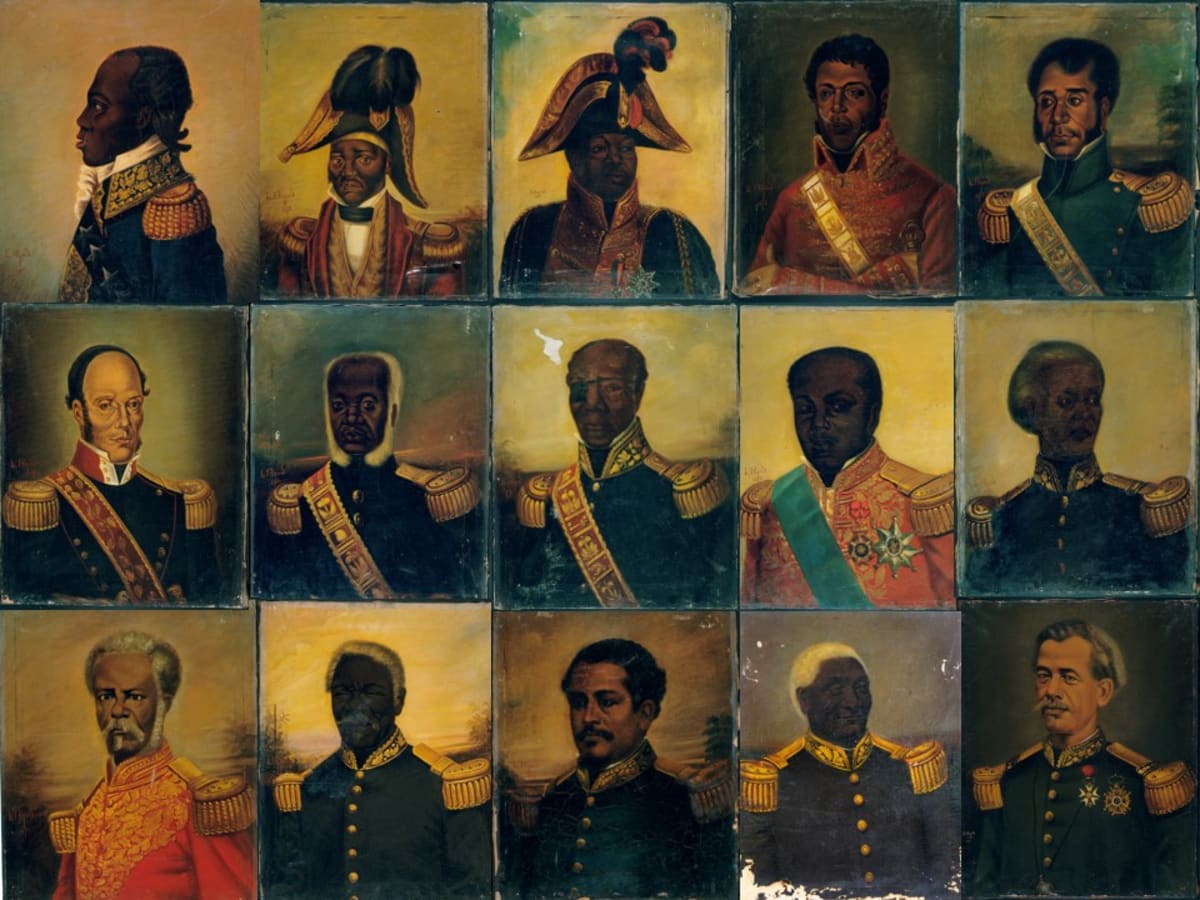
For me, the danger in focusing on what is lost is that it often obscures the abundance of what remains, e.g. the somewhat miraculous survival of the fifteen Lafargue Rigaud portraits in the Peabody Collection, which are the subject of the exhibit I am co-curating at the museum, to open this fall. Indeed, the belief that archival records and historical documents about certain kinds of people, nations, and societies are inevitably and irretrievably scarce has in some fields become its own kind of impeding, if not self-fulfilling, mantra.
Instead, what I hope to see more of across historical writing are inventive approaches that give sway to attitudes of abundance rather than mentalities of loss. After all, knowing where to look is only half the battle; the other half is actually going to look for it.
How to cite this article: Marlene L. Daut, "The (Haitian) Archive is not Scarce: Approaching Research with an Abundance Perspective," King of Haiti's World Blog, September 22, 2026. <https://marlenedaut.com/blog/the-haitian-archive-is-not-scarce-approaching-research-from-an-abundance>
(Image Credit: Compiled images of the fifteen L. Rigaud portraits of Haitian figures in the Peabody Collection before their restoration, 2012. Photograph by Mark Aronson. Peabody Museum, Yale University.)