By MARLENE L. DAUT
From 1877 to 1881, Faustin Lafargue Rigaud (known in his day simply as Lafargue Rigaud or L. Rigaud), painted seventeen portraits of Haitian rulers, from Toussaint Louverture, in the colonial era, to Lysius Salomon (1879-1888), president at the time the portraits were completed. However, one of the paintings, that of General Michel Louis Polémon Lorquet, has thus far puzzled researchers.
The Lorquet portrait is the only one among this suite of rare Rigaud paintings, originally sent across the seas to represent Haiti at the World’s Industrial and Cotton Centennial in New Orleans (1884-85), which does not represent a Haitian ruler or head-of-state.
In the upcoming museum exhibit, Haiti in the Age of Revolutions: Lafargue Rigaud’s Portraits of Independence,* my co-curator and I decided to focus on how the portraits uniquely capture Haitian statecraft and political experimentation, as the island went from a French colony to an independent state, then an empire, then a simultaneous republic/state, followed by a simultaneous republic/kingdom, before becoming one republic. Precisely because his portrait did not fit within this mold, we made the difficult decision not to feature the Lorquet painting among the heads-of-state, although Lorquet, as one of the original seventeen, does appear elsewhere in the exhibit.
While we felt that we could not fully explain the inclusion of Lorquet in the limited exhibit space we had to devote to the role of Black portraiture in nineteenth-century Haitian statecraft, as I continued to research Lafargue Rigaud’s biography, a nagging question kept surfacing in my mind: why did Rigaud include Lorquet among this pantheon of Haitian rulers? To answer this question, I needed to learn more about Lorquet’s own biography.
General Michel Louis Polémon Lorquet was born in Port-au-Prince on December 5, 1825, to Julien Lorquet and Marie Coussine Sarthe. After finishing school, like his father, Lorquet joined the Haitian army, eventually becoming secretary to General Balthazar Inginac, secretary of state under President Jean-Pierre Boyer (1818-43). Lorquet initially fled to Jamaica with Boyer in 1843 when the latter was overthrown in a coup d’état, but Lorquet returned to Haiti in 1845. Lorquet then served as a judge in the government of emperor Faustin I (otherwise known as Soulouque) (1847-59).
Under President Fabre Geffrard (1859-67), Lorquet was appointed Chief Justice, Minister of Instruction, and temporary commander of the Haitian army, attaining the rank of general on November 11, 1865. Although he had previously been aide-de-camp to future Haitian president Sylvain Salnave (1867-69), Lorquet presided over the military commission that sentenced President Salnave to death in 1870 for “high treason, devastation, arson, armed looting, and assassination.”
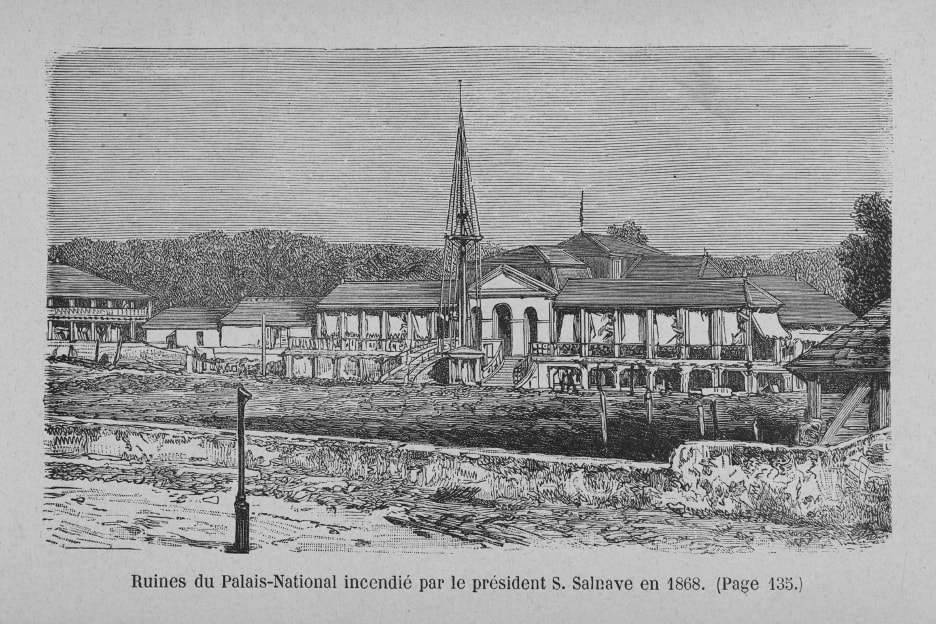
(Ruins of the Haitian National Palace, burned during the rebellion of President Sylvain Salnave. Image from Edgar La Selve’s Le Pays des nègres. La Selve gets the date wrong, however, as Haiti’s first National Palace burned down in 1869, not 1868, as the original caption reads).
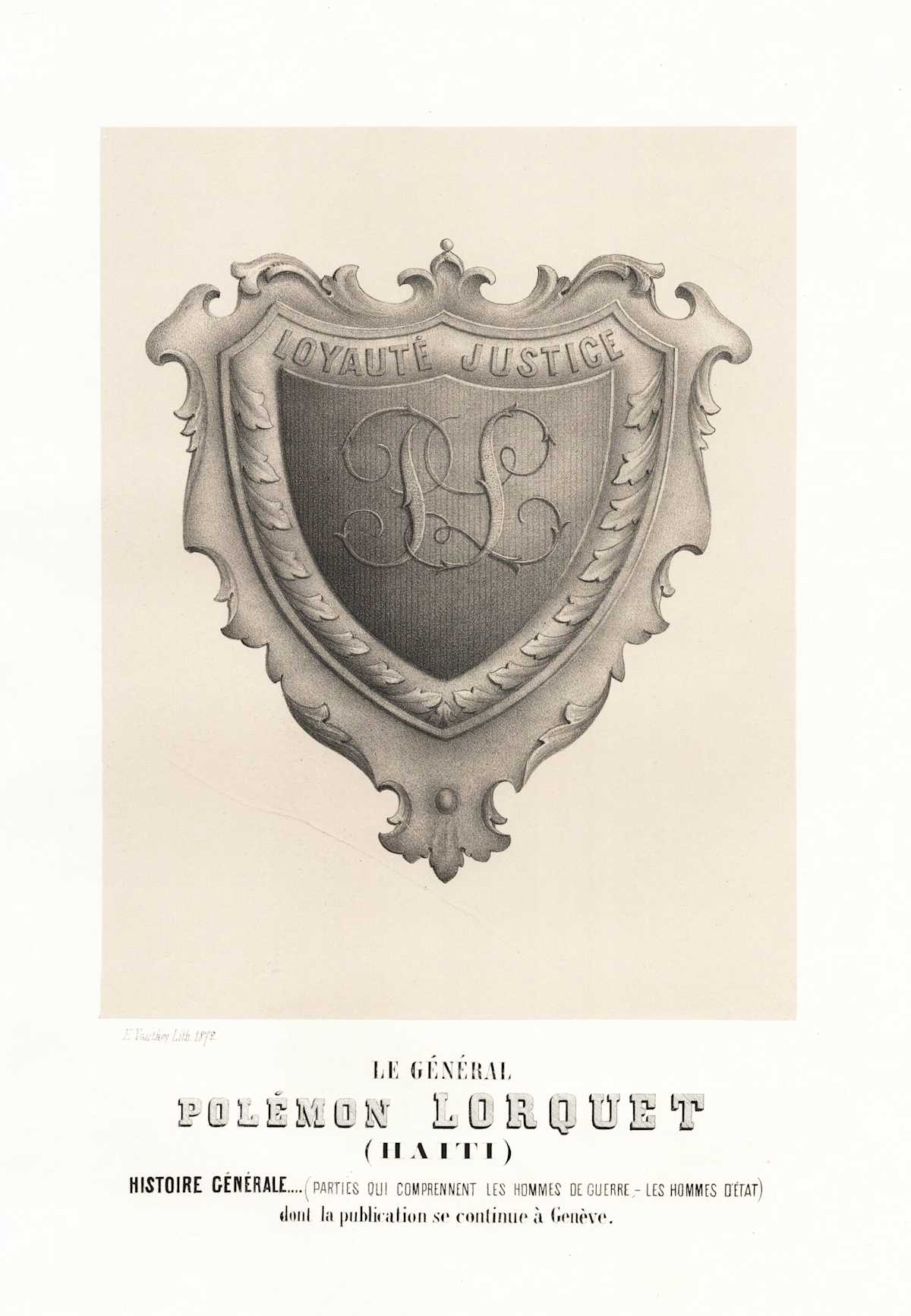
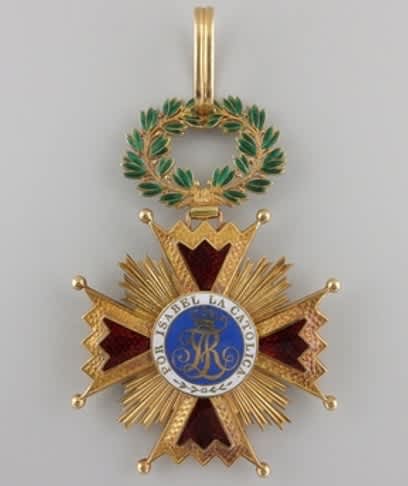
In 1872, a lithograph of Lorquet that strongly resembles Lafargue Rigaud’s portrait of him was published in Geneva as a part of a general collection of military men and heads of state. Notably, in contrast to the lithograph, which was signed E. Vauthey, Rigaud’s later oil-on-canvas portrait of Lorquet features the general wearing the Spanish order of Isabel la Catolica (Queen Isabelle, Her Catholic Majesty) and the French légion d’honneur, for which Lorquet was internationally renowned.
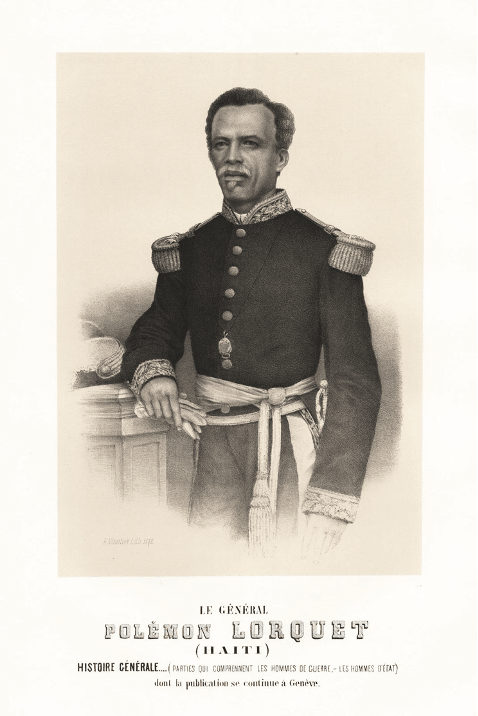
(General Polémon Lorquet, from the Swiss series Histoire générale, published in Geneva, 1872)
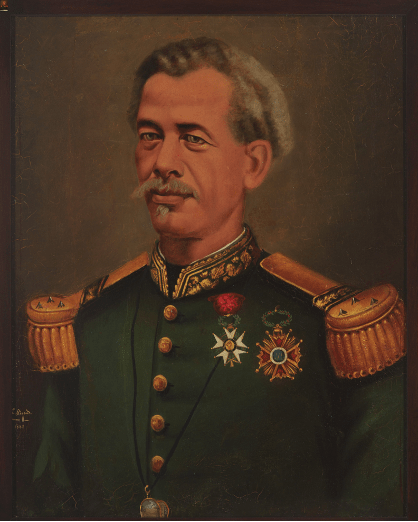
(Lafargue Rigaud's portrait of General Michel Louis Polémon Lorquet with his Spanish and French decorations, 1881, Yale Peabody Museum)
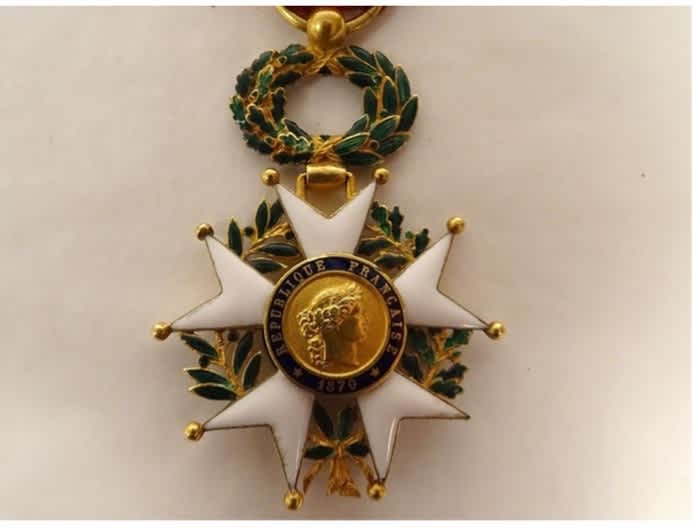
(Version of the French légion d’honneur issued during France's third republic in 1870 and featuring la Marianne for the first time. The medal remained essentially unchanged until 1940)
If Lorquet was famous abroad, he was also exceedingly respected in Haiti. As a high-ranking government official under multiple administrations, the official newspaper for the Haitian republic, Le Moniteur, contains dozens of decrees, letters, and other documents signed by Lorquet. In its February 28, 1874 issue, Le Moniteur also reported with great detail the ceremony at which the French government conferred the legion of honor upon both Lorquet and President Nissage Saget (1870-1874), the only Haitian ruler of the nineteenth century to voluntarily transfer power to his successor.
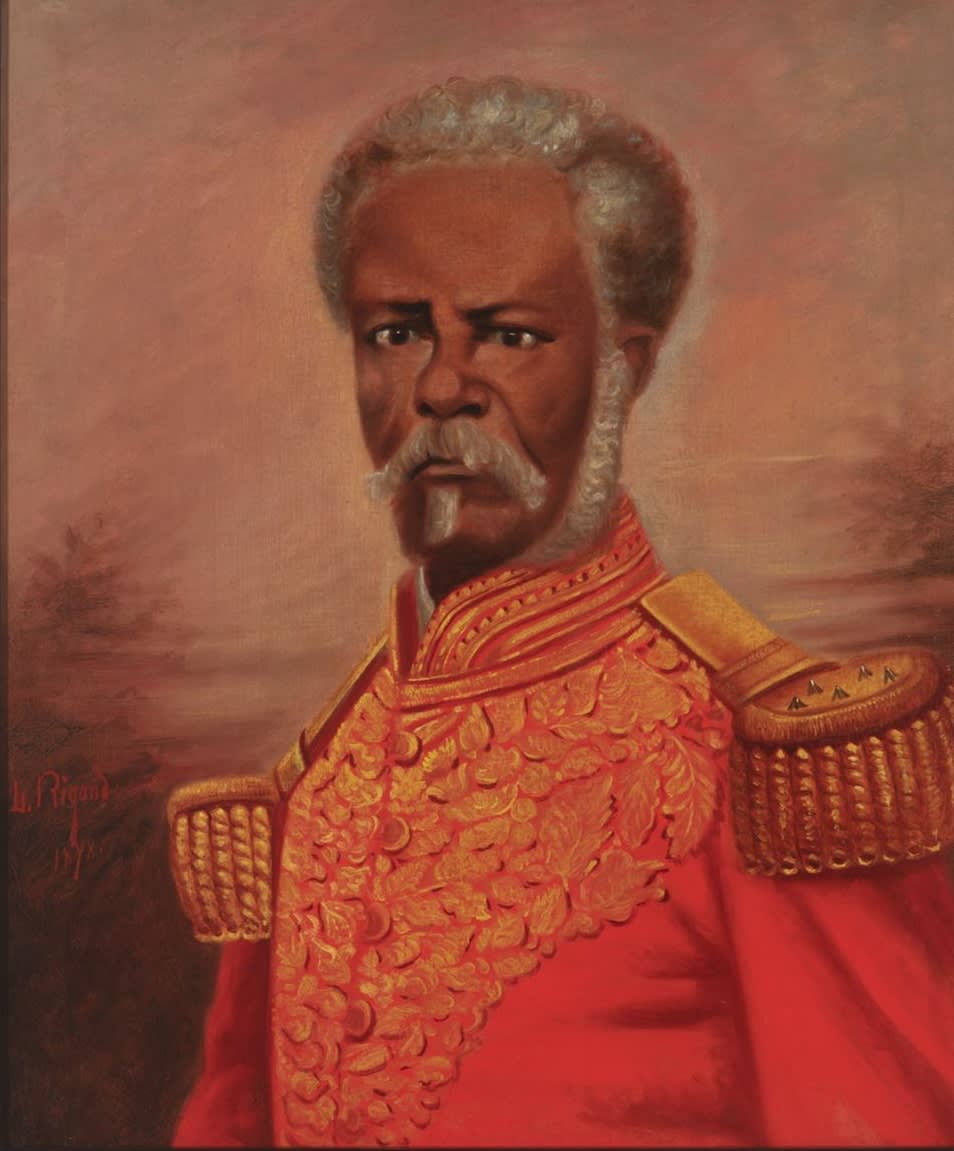
(Lafargue Rigaud's portrait of President Nissage Saget, 1878, Yale Peabody Museum)
Saget received the second-highest rank of “grand-officier,” while Lorquet received the lesser but no less illustrious rank of “officier." Le Moniteur reprinted the text of Louis-Charles-Élie-Amanien's, the Duc Decazes and French Minister of Foreign Affairs, December 18, 1873 citation for the medal of honor given to Lorquet, as follows:
“I have the honor to inform you that the President of the Republic, wishing to give you a special token of his esteem and goodwill, has conferred upon you, by Decree dated December 17, 1873, and issued upon my proposal, the Cross of Officer of the Legion of Honor.
It has been a great pleasure to be able to demonstrate to the President the merits you have earned in relation to this mark of distinction, and I hasten to transmit to you the insignia and the title of appointment intended for you.”
Yet it was not only Lorquet, as general and politician, who was of international renown, but also his likeness. In 1882, the famous French writer, Edgar La Selve, author of Le Pays des nègres (1881), and frequent collaborator with Haitian journalists and known Lafargue Rigaud associates like J.J. Audain (see La Revue exotique), began advertising a Haitian picture show that would appear across theatres in the French colony of Algeria. Appearing under the titles Voyage au Pays des Nègres and Voyage au Pays des Mulâtres, the advertisements for the show—as published in several Algerian newspapers, such as Le Radical Algérien (August 19, 1882) and Le Réveil de Mascara (August 5, 1883)—promised viewers an elaborate photographic display, produced after the limestone light projection method invented by Thomas Drummond (called also la lumière oxhydrique).**
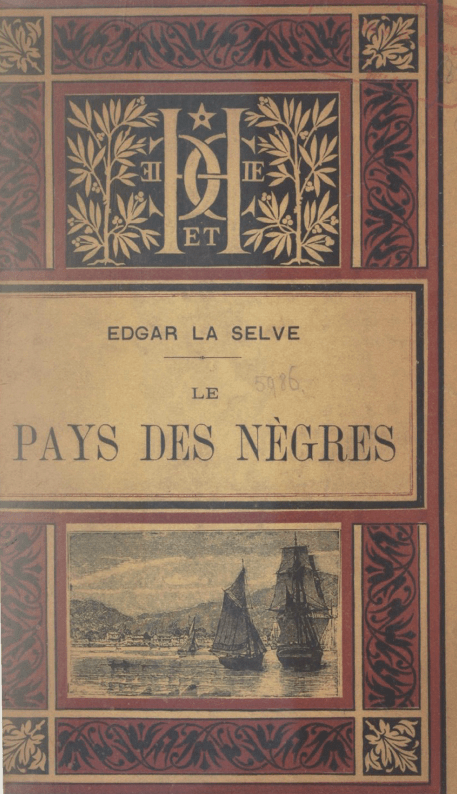
(Cover of La Selve’s Le Pays des negres [1881])
The “list of projections, made from photographs or sketches of exact likeness,” included Haitian women and children, churches, forts, streets, waterways, ports, homes, city landscapes, and many other structures, most notably, the Haitian National Palace, along with Henry Christophe’s Palace at Sans-Souci and the Citadelle Laferrière. Several Haitian leaders were also among the photographic projections, namely, Soulouque (Faustin I), Christophe (Henry I), Nissage Saget, Sylvain Salnave, Fabre Geffrard, along with Michel Domingue and his wife. The list also included a few Haitian military generals and regional commanders, among whom Polémon Lorquet’s name appears.
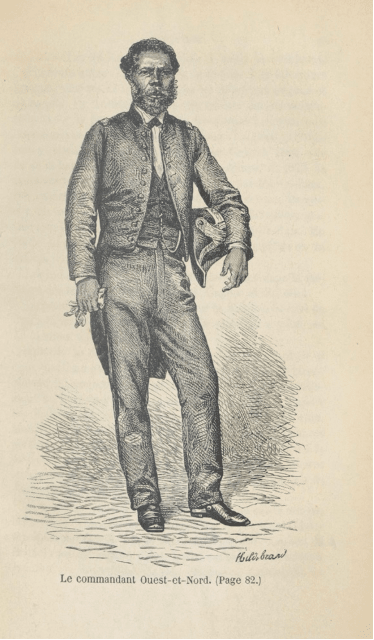
(The Commander of the West and North of Haiti, as produced in La Selve’s book, Le Pays des nègres. He was among those included in the photographic projections on display in Algeria)
While it is not known whether the projection of Lorquet in La Selve’s show resembled the impressive portrait painted by Lafargue Rigaud—and Lorquet’s image does not appear in La Selve’s 1881 book—the connection between Rigaud and Lorquet may, in fact, reside in the Rigaud family's political history. Lafargue Rigaud’s father, Auguste Rigaud, served under every Haitian ruler from Soulouque until at least Salomon (August Rigaud died in the early 1890s). By the time Rigaud painted the suite of portraits that included Lorquet, his father had been a high-ranking member of the Haitian chambre des comptes (board of auditors) for a few decades. It is therefore more than possible that it was through his father, a noteworthy government official in his own right, that our Lafargue Rigaud became acquainted with the evidently alluring life and likeness of Lorquet.
A profile of Haiti and the Dominican Republic that appeared on April 22, 1873 in the New York Herald perhaps best captures what an evocative subject Lorquet, commander at the time over the arrondissement of Port-au-Prince, seems to have been for writers and artists alike. Remarking upon his “Jacksonian mould—rugged, stubborn, clear-headed,” the Herald writer declared Lorquet to have the “eye of an eagle and the face of a roused lion, before whom all alone armed mobs have quelled and melted away.” The writer then rather provocatively insisted, “They have a man in Hayti who could make her happy and prosperous, because he is enlightened beyond his fellows and has a will of iron, if he would only seize the reins of power and put an end to the mockery of law and liberty carried on in the name of a republic. That is General Lorquet.” Going on to speak of an “interesting interview” he had with the general, the Herald writer concluded, “He is a power with the masses. […] great confidence is placed in him by all classes.”
This popularity would not last forever. Lorquet died in Haiti during the April 15-16, 1876 coup d’état that drove his ally President Michel Domingue from the country. Lorquet left behind a wife (Luce Sterline Sterlin, according to their October 8, 1870 acte de mariage) and one son (possibly, also named Polémon Lorquet).
Several obituaries subsequently ran in the U.S. press, including in the New York Herald, which reported on April 21, 1876—noticeably devoid of the kind of ostentatious editorializing contained in its earlier 1873 profile—that Lorquet “was decorated with the Spanish Order of Isabel la Catolica,” and had “just met his death in Hayti in defence of the government of President Domingue.” The Lorquet obituary was directly followed by one for Haiti’s first vice-president, Septimus Rameau, a native of Aux Cayes, reportedly, “shot by the insurgents.”
Haitian newspapers transmitted this news in an even less ceremonious manner than the Herald. In fact, Lorquet and Rameau garnered only a pithy but acerbic mention by A. Laforestrie, who characterized both men as “enemies” of the Haitian Republic in an article he published in Le Moniteur on April 22, 1876, nearly a week after their deaths. Laforestrie wrote:
“General Septimus Rameau paid with his life for the crimes he had committed, General Lorquet followed him to the grave; we will not say that this is good news for the country, the Revolution [against President Domingue] is of too much importance for us to rejoice in the death of its enemies, but may their sad fates serve as an example to those who dream of power only to satisfy their personal ambitions.”
It is not possible to know at this point how Lafargue Rigaud felt about the death of the man for whom he must have had at one point had high esteem. What we do know is that Lafargue Rigaud continued to paint and paint, mostly Haitian heads-of-state, producing portraits of every Haitian ruler—whether governor-general, emperor, president, or king—until his own death on June 3, 1910.
How to cite this article: Marlene L. Daut, "Why did Lafargue Rigaud paint Haitian general Polémon Lorquet?" King of Haiti's World Blog, October 21, 2026 <https://marlenedaut.com/blog/why-did-lafargue-rigaud-paint-haitian-general-polemon-lorquet>
*Tours of the exhibit will be given on Friday, November 13 and Saturday November 14, but space is limited. Sign up here: https://yalesurvey.ca1.qualtrics.com/jfe/form/SV_agHu4E6xurgIhh4
**Since posting this article, I came across an earlier October 1882 advertisement for the light show published in the Courrier du Dauphiné, out of Grenoble, France, which indicated that La Selve would give a lecture during the display on October 19 at the "salle des Concerts."