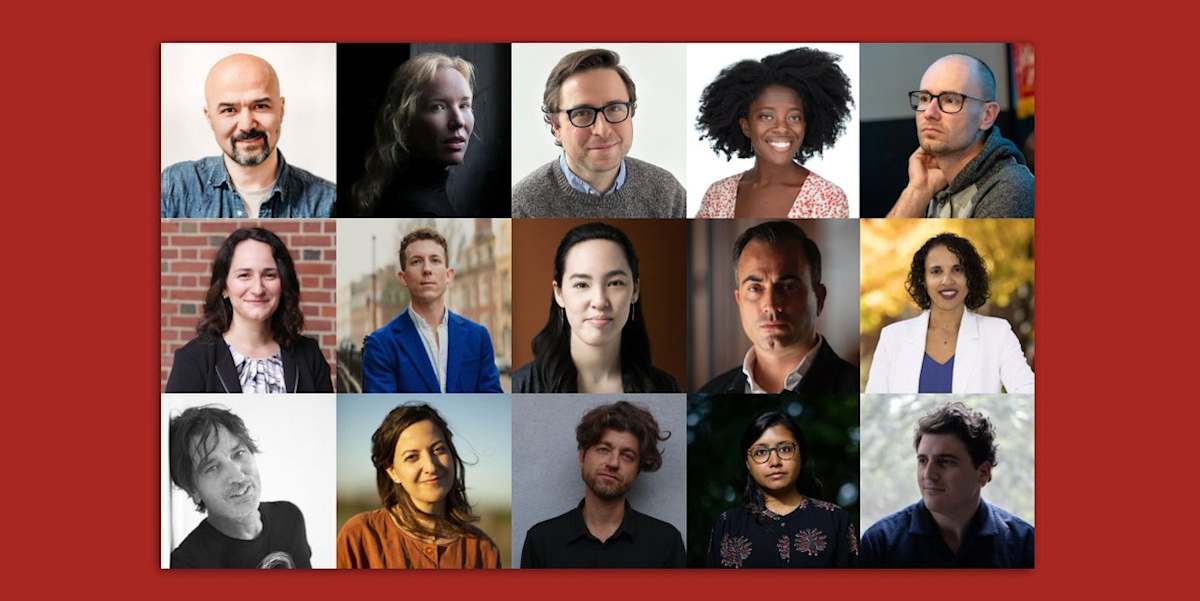
Meet the 2026-2027 Fellows of the Dorothy and Lewis B. Cullman Center for Scholars and Writers
From the official press release:
The New York Public Library’s Dorothy and Lewis B. Cullman Center for Scholars and Writers has selected 15 gifted academics, nonfiction writers, and creative writers for its 28th class of Fellows in 2026–2027. The Cullman Center is an international fellowship program open to people whose work will benefit directly from access to the collections at the Stephen A. Schwarzman Building. Books written at the Cullman Center have gone on to extraordinary acclaim and influence. In the past four years alone, they have received two National Book Critics Circle Awards, a National Book Award, and three Pulitzer Prizes.
The coming year’s Fellows were selected from a pool of over 800 applicants that included a diverse range of academics, independent scholars, novelists, playwrights, poets, and others. The 2026-2027 class of Cullman Center Fellows are:
- Academics Doyle Calhoun, Marlene Daut, Alan Shane Dillingham, and Hannah Farber
- Fiction writers Yaa Gyasi, Megha Majumdar, and Alexander Sammartino
- Nonfiction writers Rebecca Donner, Kasim Kashgar, Eric Lach, Rachel Monroe, and Ross Perlin
- Playwrights Viacheslav Komkov and Lauren Yee
- Poet Nick Flynn
"With projects that range from a biography of the Haitian president who agreed to pay France for his country’s independence, to a novel based on traditional Ghanaian folktales, to a play about a composer’s escape from the Soviet Union; this class of Cullman Center Fellows—chosen from the largest pool of applicants the Center has ever received—showcases the continuing vitality of research in the humanities,” said Salvatore Scibona, the Sue Ann and John Weinberg Director of the Cullman Center. “At a time of retrenchment elsewhere in support for scholars and writers, the Library is expanding and celebrating it."
Throughout the Fellowship term, which runs from September 2026 through May 2027, the new class of Cullman Center Fellows will have access to the renowned research collections and resources of The New York Public Library, as well as the invaluable assistance of its curatorial and reference staff. The Fellows receive a stipend of $90,000 and the use of a private office in the Cullman Center’s quarters at the Library’s landmark Stephen A. Schwarzman Building at Fifth Avenue and 42nd Street.
The Center fosters an atmosphere of creative and scholarly collaboration both within the Library and in the larger cultural environment of New York. It also hosts Conversations from the Cullman Center, a series of free public programs that focus on the books Fellows worked on while in residence at the Library.
Prize-winning and prominent past Fellows include: André Aciman, Elif Batuman, Hernan Diaz, Jennifer Egan, Álvaro Enrigue, Ada Ferrer, Annette Gordon-Reed, Saidiya Hartman, Hua Hsu, Mitchell S. Jackson, Leslie Jamison, Patrick Radden Keefe, Hermione Lee, Larissa MacFarquhar, Richard McGuire, Lorrie Moore, Jennifer L. Morgan, Sally Rooney, Dash Shaw, Colm Tóibín, Justin Torres, Edmund White, Colson Whitehead, and many more.
For more information about the Center, its current and former Fellows, and its programs for teachers and the general public, visit www.nypl.org/csw.
About the 2026–2027 Fellows
Doyle D. Calhoun
Africa After 1848: Remaking Abolition in the French-Speaking World
Doyle D. Calhoun is an assistant professor of francophone postcolonial studies at the University of Cambridge, where he is a fellow of Peterhouse and an affiliated lecturer in film and screen studies, African studies, and history. He is the author of The Suicide Archive: Reading Resistance in the Wake of French Empire, which received the Aldo and Jeanne Scaglione Prize for French and Francophone Studies from the Modern Language Association. He has edited and translated several volumes, including The Essential Senghor: African Philosophy and Black Aesthetics (with Alioune Fall and Cheikh Thiam). His work has been supported by fellowships from the Fulbright Program, the Camargo Foundation, the Leverhulme Trust, and the Bibliothèque Marmottan. He received his PhD from Yale University in 2022. At the Cullman Center, he will work on Africa After 1848: Remaking Abolition in the French-Speaking World, examining how chronologies and understandings of abolition were reimagined across West and North Africa through intra-African and trans-Saharan networks.
Marlene L. Daut
Making Haiti Pay: Jean-Pierre Boyer, French Extortion, and the Fight for Global Reparations After Slavery
The John and Constance Birkelund Fellow
Marlene L. Daut is a professor of French and Black studies at Yale University. Her most recent book, The First and Last King of Haiti: The Rise and Fall of Henry Christophe, won the Gilbert Chinard Prize from the Society for French Historical Studies and the Haitian Studies Association Book Prize, and was a finalist for the Cundill History Prize. Her other books include Tropics of Haiti: Race and the Literary History of the Haitian Revolution in the Atlantic World and Awakening the Ashes: An Intellectual History of the Haitian Revolution, co-winner of the Frederick Douglass Book Prize. Her writing has appeared in numerous publications, including the New Yorker, the New York Times, Harper’s Bazaar, Essence, and the Nation. In 2026, she was awarded a Guggenheim fellowship. At the Cullman Center, she will work on a biography of Haitian revolutionary turned president Jean-Pierre Boyer, whose greatest claim to (unfortunate) fame was signing an 1825 agreement whereby he committed Haiti to pay 150 million francs to France as the price of French recognition of Haitian independence.
Photo: Daniel Robles
Alan Shane Dillingham
We Never Walk Alone: A Story of Family, Dispossession, and Slavery in Indian Territory
Alan Shane Dillingham is a historian of the Indigenous Americas. He is the author of Oaxaca Resurgent: Indigeneity, Development, and Inequality in Twentieth-Century Mexico, which the American Society for Ethnohistory selected for its Erminie Wheeler-Voegelin Book Award and the Conference on Latin American History selected for its María Elena Martínez Prize in Mexican History. Dillingham is the recipient of fellowships from the National Endowment for the Humanities, Stanford University's Center for Advanced Study in the Behavioral Sciences, and the American Council of Learned Societies. He teaches at Arizona State University’s School of Historical, Philosophical, and Religious Studies, and serves on the editorial boards of the Radical History Review and Labor: Studies in Working-Class History. At the Cullman Center, he will work on a nonfiction book that explores his own family history to better understand the consequences of conquest and colonialism.
Photo: Beowulf Sheehan
Rebecca Donner
I Am Sophie Scholl
Rebecca Donner has been a fellow at the Harvard Radcliffe Institute for Advanced Study, a visiting scholar at Oxford, and a Guggenheim fellow. In recognition of her contribution to international historical scholarship, she was elected a fellow of the Royal Historical Society. Donner’s third book is the New York Times bestseller All the Frequent Troubles of Our Days, a fusion of biography, espionage thriller, and scholarly detective story about her great-great-aunt Mildred Harnack, an American graduate student who became a leader of one of the largest underground resistance groups in Germany during the Nazi regime. All the Frequent Troubles of Our Days won the National Book Critics Circle Award for biography, the PEN/Jacqueline Bograd Weld Award, and the Chautauqua Prize. Other honors include a 2018-19 fellowship at the Leon Levy Center for Biography. At the Cullman Center, she will work on a genre-defying biography of Sophie Scholl.
Hannah Farber
The American Lawsuit
The Andrew W. Mellon Foundation Fellow
Hannah Farber is a professor of early American history at Columbia University, specializing in the history of money, commerce, and property. She is the author of Underwriters of the United States: How Insurance Shaped the American Founding, which received awards from the Business History Conference and the North American Society for Oceanic History. She serves as a series editor for American Beginnings: 1500–1900 at the University of Chicago Press. At the Cullman Center, she will work on The American Lawsuit, a history of civil litigation in the early United States that explains why Americans sued each other so often and what they typically got out of their lawsuits. In the process, The American Lawsuit sheds light on the credibility of the American justice system, on vast contests over material resources, and on litigation's uneasy relationship with American democracy.
Nick Flynn
Soon We Will All Once Again Be Ocean
Nick Flynn is the author, most recently, of the poetry collection Low. His book Stay chronicles his work with other artists (filmmakers, visual artists, musicians, etc.) over the past 25 years. His bestselling memoir Another Bullshit Night in Suck City was made into a film starring Robert DeNiro and has been translated into 15 languages. At the Cullman Center, Flynn will work on a hybrid sequence of prose poems about the years he lived on boats and his friendship with the artist Richard Booton, who died of AIDS in 1994.
Photo: Peter Hurley / Vilcek Foundation
Yaa Gyasi
Kwaku Ananse: A Novel
Yaa Gyasi was born in Mampong, Ghana, and raised in Huntsville, Alabama. Her first novel, Homegoing, won the National Book Critics Circle’s John Leonard Prize for best first book, the PEN/Hemingway Award, and the American Book Award. In 2016, Gyasi was selected as one of the National Book Foundation’s 5 under 35 honorees. Her second novel, Transcendent Kingdom, was a finalist for the Women’s Prize. At the Cullman Center, she will work on a novel about human interaction with other creatures, with each other, and with the Earth, using the classic Ghanaian "Anansi the Spider" stories as scaffolding.
Kasim Kashgar
Good That Mother Was Gone Before She Could Witness This: A Uyghur Son's Search for Survival and Voice
Kasim Kashgar is a journalist and memoirist who served as Voice of America's first dedicated Uyghur reporter, publishing more than 300 stories in English and Mandarin and creating VOA's first Uyghur-language digital video program. He previously founded one of the largest private language schools in western China. The recipient of a Kiplinger fellowship and a Witness Institute fellowship, he is the subject of the documentary From Fear to Freedom: A Uyghur's Journey, which won a gold award at the 2024 New York Festivals TV & Film Awards. At the Cullman Center, he will work on his memoir, Good That Mother Was Gone Before She Could Witness This: A Uyghur Son's Search for Survival and Voice, which traces the fate of the Uyghur people in China and across the diaspora through one person's story of memory, loss, survival, and what it means to belong to a people facing erasure.
Viacheslav Komkov
Not Back to the USSR
Viacheslav Komkov is a Russian playwright, prose writer, and documentary filmmaker. For nearly 20 years, he worked in the production of documentary films, entertainment television, and special reports. His debut play, Cormorant, Chubby, and Cockroach, explores the phenomenon of volunteer vigilante groups that emerged in Russia in the 2010s. The play was recognized as one of the winners of the Remarque Playwriting Award. His mystical drama Fish Eye revolves around a family curse, referencing the story of Cain and Abel while preserving the everyday routines and habits of children who grew up in 1990s Russia. Fish Eye was a winner of the Playwrights' Workshop competition and was staged for several years in one of Moscow’s independent theaters. At the Cullman Center, Komkov will work on a play about a Soviet composer who, at the height of the Cold War, seeks political asylum in the United States while on tour.
Eric Lach
Tear Down, Build Over
The Janice B. and Milford D. Gerton / Arts and Letters Foundation Fellow
Eric Lach is a contributing writer at the New Yorker, where he writes frequently about the workings and politics of New York City. At the Cullman Center, he will work on a history of New York told in real estate deals, titled Tear Down, Build Over. Covering four hundred years, with a focus on transactions both large and small, the book will shed light on the convergence of real estate with major social issues including racial justice, class warfare, and public funding, and will interrogate the debate on the future of urban life in the 21st century.
Photo: Marco Giugliarelli for the Civitella Ranieri Foundation
Megha Majumdar
No Indian Can Know English: A Novel
The Rona Jaffe Foundation Fellow
Megha Majumdar is the author of the bestselling novel A Guardian and a Thief, which was an Oprah’s Book Club pick, a finalist for the Kirkus Prize and the National Book Award, longlisted for the Women's Prize and the Carol Shields Prize, and the winner of the American Library Association’s Carnegie Medal for Excellence. Her first book, A Burning, was a TODAY Show “Read With Jenna” Book Club pick and was longlisted for the National Book Award, among other honors. In 2026, Majumdar was awarded a Guggenheim fellowship. At the Cullman Center, she will work on a novel about South Asian art on Broadway, focused on a Bengali playwright and director who seeks to mount a play inspired by the complicated friendship between poets W. B. Yeats and Rabindranath Tagore.
Rachel Monroe
Dead Reckoning
Rachel Monroe is a contributing writer at the New Yorker where she primarily covers Texas and the Southwest. She is the author of Savage Appetites: True Stories of Women, Crime, and Obsession, which was named a New York Times Editors’ Choice and a best book of the year by the Chicago Tribune, Esquire, and Jezebel. Her writing has been published in the Atlantic, Harper’s, the New York Times Magazine, Esquire, Wired, and Outside, as well as anthologized in The Best American Travel Writing 2018. She has been the recipient of a Fulbright fellowship and a finalist for the Livingston Award for Young Journalists. At the Cullman Center, she will work on a book about the Mutter Museum in Philadelphia and the past, present, and future of collections of human remains.
Ross Perlin
Translation: An Alternative History from Jesus to AI
Ross Perlin is the author of Language City: The Fight to Defend Endangered Mother Tongues in New York, which was awarded the British Academy Book Prize and the New York City Book Award, longlisted for the Carnegie Medal, and named a New York Times Notable Book. He is co-director of the non-profit Endangered Language Alliance, where he has overseen research projects focused on language documentation, mapping, policy, and public programming. He teaches linguistics at Columbia University and has been a fellow at the American Academy in Berlin and at the New America program. At the Cullman Center, he will work on a book about the history of translation and the race by missionaries, linguists, language activists, and AI companies to reach every language in the world.
Alexander Sammartino
Untitled Novel
The Mary Ellen von der Heyden Fellow
Alexander Sammartino’s debut novel, Last Acts, won The New York Public Library Young Lions Fiction Award, was shortlisted for the Bollinger Everyman Wodehouse Prize for Comic Fiction, and was a New York Times Editors’ Choice. Sammartino was also chosen as a National Book Foundation 5 Under 35 honoree. His next novel, Gallo, is forthcoming in March 2027. At the Cullman Center, he will work on a novel about the twentieth anniversary of 9/11.
Photo: Beowulf Sheehan
Lauren Yee
Untitled Play
The Jean Strouse Fellow
Lauren Yee is a playwright and screenwriter based in New York. Her plays include Cambodian Rock Band (staged at South Coast Rep, Oregon Shakespeare Festival, La Jolla Playhouse, Signature Theatre), The Great Leap (Denver Center, Seattle Rep, the Atlantic, Steppenwolf, ACT), King of the Yees (Goodman Theatre, Center Theatre Group), and Mother Russia (Seattle Rep, Signature Theatre). Her honors include the Doris Duke Artist Award, the Whiting Award, the Steinberg/American Theatre Critics Association New Play Award, the Horton Foote Prize, and the Kesselring Prize. Her TV writing credits include Pachinko (Apple), Soundtrack (Netflix), Interior Chinatown (Hulu), Billions (Showtime), and Clipped (FX). At the Cullman Center, she will work on a play about a Chinese American family in San Francisco grappling with rising anti-Communist sentiment—and suspicions about their own allegiances—as a wayward son returns home.
The Cullman Center is made possible by a generous endowment from Dorothy and Lewis B. Cullman in honor of Brooke Russell Astor, with major support provided by Mrs. John L. Weinberg, The Andrew W. Mellon Foundation, The Estate of Charles J. Liebman, The von der Heyden Family Foundation, John and Constance Birkelund, and The Samuel I. Newhouse Foundation, and with additional gifts from Helen and Roger Alcaly, The Rona Jaffe Foundation, The Arts and Letters Foundation Inc., William W. Karatz, Merilee and Roy Bostock, and Cullman Center Fellows.