By MARLENE L. DAUT
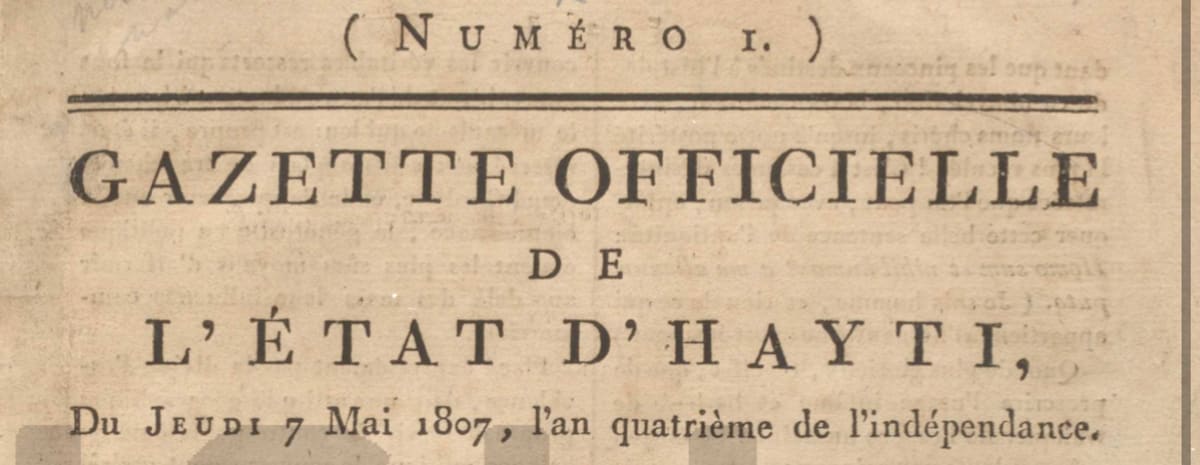
On May 7, 1807, three months after Christophe issued a new constitution for northern Haiti, over which he ruled as president and generalissimo, the first issue of the new state run newspaper appeared under the title of the Gazette officielle de l'état d'Hayti, or the Official Gazette of the State of Hayti. In the opening paragraph of the paper, the editor, Juste Chanlatte, notes that the enemies of Christophe’s newly established state, which is to say Alexandre Pétion and his conspirators in the south, had disrupted the publication of Haiti’s former national newspaper, the Gazette Politique et Commerciale d’Haiti (Political and Commercial Gazette of Haiti), issued during Jean-Jacques Dessalines’s short-lived reign as emperor Jacques I (1804-1806).
Chanlatte went on to say that he was offering the Gazette Officielle in the interest of being “useful to my fellow citizens.” He further explained:
“The insatiable ambition of certain individuals, who, under the guise of modesty and selflessness, seek to devour the treasures of the Nation and invade the powers of the State, and who interrupted the circulation of the Political and Commercial Gazette of Haiti, along with the desire to be useful to my fellow citizens, to inform them of the Acts of the Government, of the entry and exit of ships, to advise them of the various opportunities we have for commercial relations, and of political events, both external and internal, has determined me to undertake this publication, which will henceforth be known as the Official Gazette of the State of Hayti.”
The first issue of the Official Gazette begins with a characteristic quote from Voltaire, "Chaque Peuple, à son tour, a brillé sur la terre," which translates literally as, “Each People, in its turn, has shone upon the earth.” Chanlatte, in fact, was known to have quite an affinity for Voltaire.
All the known issues of the Official Gazette from the years 1807-1809, still edited by Chanlatte, contain the same epigraph from Voltaire’s five-act tragedy Mahomet (1736). Yet in the June 14, 1810 issue of the Gazette, published the very year that Chanlatte published his first book-length work Le Cri de la Nature, he changed the epigraph from Mahomet, which had been in place for three years, to a quotation from the noted abolitionist the abbé Grégoire’s anti-slavery anthology De la Littérature des Nègres (1808). The powerful quote preceding the new issues then read, “The friends of slavery are necessarily the enemies of humanity.”
But by January 3, 1811, Chanlatte had changed the epigraph back to Voltaire, this time drawing from his 1760 heroic tragedy, Tancrède: “Friends! Let there be only one party among us; that of the public good and the safety of all!”
Henry Christophe established a monarchy in March 1811, which was followed by a change in name for Chanlatte, now the Comte de Rosiers, and of the national newspaper to the Gazette Royale d’Hayti, or the Royal Gazette of Hayti.
The first known issue of the royal newspaper (ostensibly still edited by Chanlatte/Rosiers), dated July 22, 1813, contains yet another change in epigraph, and thus another quote from Voltaire. Chanlatte took the new epigraph from Voltaire's 1742 tragedy, Mérope. Seemingly celebrating the creation of the monarchy, the new epigraph read, “The first to be king was a happy soldier/Who serves his country well does not need predecessors."
If we go back to the first issue of the Official Gazette, however, we see that in addition to championing Haiti's independence and newfound statehood under Christophe from a literary, poetic, philosophical, and political standpoint, Chanlatte's other beat was naturally the abolition of slavery, including the slave trade. While Chanlatte was, of course, concerned with explaining internal affairs to the Haitian populace, which he stated at the outset, he also had some momentous international news to report.
“It is most gratifying for us to announce to our fellow citizens that the abolition of the slave trade has finally been decided in the Imperial Parliament of Great Britain,” Chanlatte wrote. “Out of 283 total votes cast for this motion, only 16 were against; a majority of 267 votes ensured its triumph, to the great satisfaction of those who feel that this decision is a step towards the freedom and independence of the West Indies.”
Observe that for Chanlatte this decision represented just one important "step" towards the independence of the Caribbean as a whole. This reinforces historian Julia Gaffield's recent argument in her book I Have Avenged America that in Haitian thought "independence and abolition went hand in hand." This is why Haiti's first constitution, issued in May 1805 under Dessalines, and undersigned by Chanlatte, permanently outlaws slavery (including the slave trade) and re-declares the independence of Haiti.
The way that Chanlatte ended his reportage of Great Britain's abolition of the slave trade also merits attention. For it is in one of the last paragraphs that Chanlatte coined the phrase “crime against humanity” in the context of slavery.
“What could be more glorious, indeed, than to outlaw the infamous and barbaric practice of trafficking in human beings?” he asked. “How could one possibly conceive that this shameful mania could have persisted until now, after so many streams of erudition and philosophy have been poured across the globe! Surely, only he, who, at birth, suckled the milk of a tigress, could have allowed this diabolical idea to have entered his brain; how ferocious was that people who dared to teach others to tolerate such a crime against humanity!”
Although the contemporary world now stands in near universal agreement that slavery is morally wrong and abhorrent—and that, along with the slave trade, slavery constituted a "crime against humanity"—Haiti’s role in bringing about this global consensus has been conveniently forgotten.
In 1945, the Nuremburg Charter, created in response to the Holocaust, did not acknowledge Haiti's or Chanlatte’s 1807 precedent, when it declared slavery a “crime against humanity.” When that statement was repeated by the International Court of Justice in 2001, Haiti’s previous usage of the term in the context of slavery was once more silenced. Perhaps even more tellingly—or damningly—when France passed the Taubira Law, also in 2001, which legally made slavery and the slave trade “crimes against humanity,” nowhere was was France's former colony, Haiti, mentioned.
A new history lesson for the world, therefore, remains in order.
As I wrote for Public Books back in 2024, on the occasion of the 220th anniversary of Haitian independence: “To fully understand the momentousness of Haiti’s inaugural and largely silenced role in defining the modern freedoms the world now takes for granted—by outlawing slavery and declaring it and the slave trade crimes against humanity—we must dispense with the idea that New World Africans were mere hitchhikers on a highway of historical progress, inordinately moving forward along with the one-way traffic that took the world from slavery to freedom. The Haitian Revolution, long excluded from traditional accounts of the age of abolition, was in fact its heart.”
How to cite this article: Marlene L. Daut, "On This Day in Haitian History (May 7, 1807): The First Issue of the Official Gazette for the State of Hayti is Published," King of Haiti's World Blog, May 7, 2026 <https://marlenedaut.com/blog/on-this-day-in-haitian-history-may-7-1807-the-first-issue-of-the>