By MARLENE L. DAUT
Next week, on February 25, I will be appearing at Museum of the American Revolution in Philadelphia as a part of the Read the Revolution series alongside my good friend and colleague Julia Gaffield. We will certainly be discussing the American Revolution, whose semiquincentennial the museum and other U.S. cultural institutions are celebrating this year (and in whose storied Battle of Savannah Henry Christophe fought). What we’ll really be there to discuss, however, is Haiti in the Age of Revolutions.
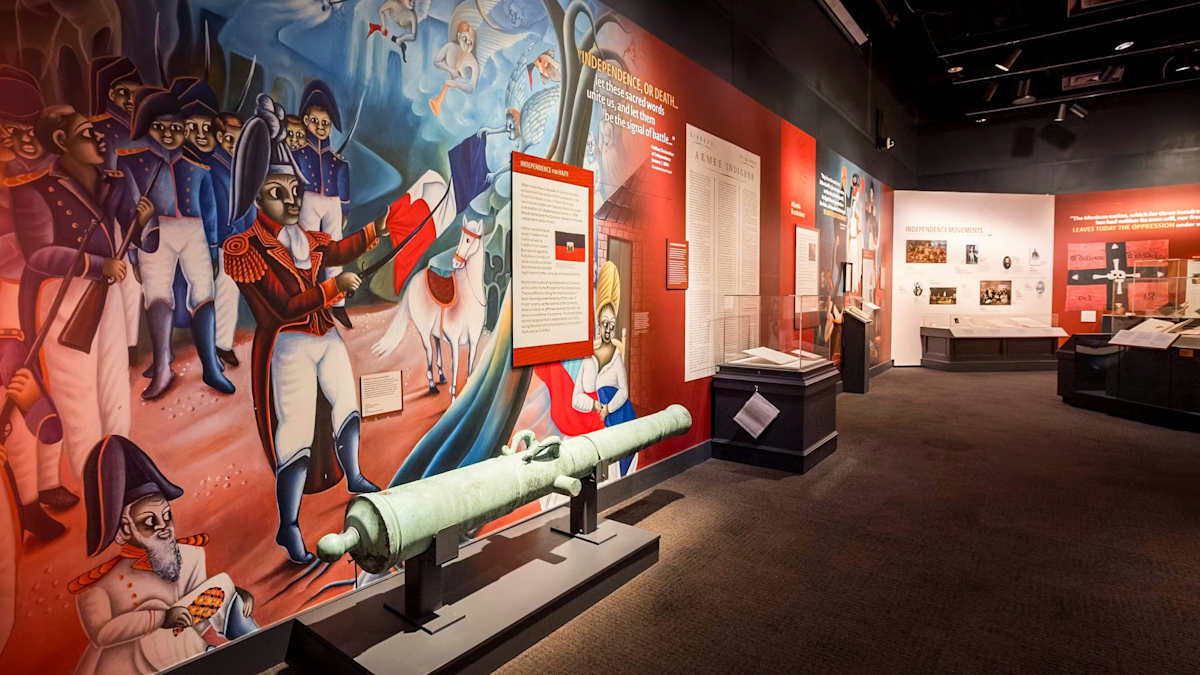
MOAR’s exhibit tracing the journey of the U.S. Declaration of Independence does, in fact, include Haiti. So, in advance of next week’s event, I thought I would seize this occasion to highlight what is distinctive and different about the Haitian Revolution and the ensuing journey of the Haitian Declaration of Independence.

Following a nearly thirteen-year freedom struggle against the French, on November 29, 1803, Jean-Jacques Dessalines, Christophe, and another general named Augustin Clervaux issued a preliminary Declaration of Independence. “In the name of the Black People and Men of Colour of St. Domingo. The independence of St. Domingo is proclaimed,” the document read. “The frightful veil of prejudice is torn to pieces. . . . We have sworn not to listen to clemency towards all those who would dare to speak to us of slavery.” By December 4, 1803, most French forces had departed from the island, marking the end of their expedition to reinstate slavery.
On January 1, 1804, Dessalines and the other freedom fighters then officially proclaimed Saint-Domingue independent from France and renamed the island Haïti, after one of its indigenous appellations, Ayiti. Aside from announcing that the island would henceforth be known as Haiti rather than Saint-Domingue, the January 1st version also notes that the Haitian people have “sworn to posterity, in front of the entire universe, to renounce France forever, and to die rather than live under her domination.”
In his famous Proclamation at Gonaïves, issued the same day, Dessalines further declared, “It is not enough to have expelled the barbarians who have bloodied our land for two centuries; it is not enough to have restrained those ever-evolving factions that one after another mocked the specter of liberty that France dangled before you. We must, with one last act of national authority, forever assure the empire of liberty in the country of our birth; we must take any hope of re-enslaving us away from the inhumane government that for so long kept us in the most humiliating torpor. In the end we must live independent or die.”
Dessalines's speech represented a fitting capstone to the only armed slave revolt and military uprising to have ended in independence for New World Africans. And by insisting that freedom could not revolve around skin color, Haiti’s freedom fighters challenged the contradictions of the western European Enlightenment, which had pronounced liberty and equality to be only for white men. Haitian independence thus remains the most significant development in the history of modern democracy, since the theories undergirding it—namely, that no human beings could ever again be enslaved—continue to define contemporary political ideas about what it means to be free.
The Haitian Declaration of Independence was followed up one year later by Haiti’s first constitution, which permanently abolished slavery and the slave trade (making Haiti the first country to ever do so). In May 1805, Haiti—which had become an empire under Dessalines, who adopted the title Jacques I—saw its first constitution ratified. Articles 2 and 3 solidified into law the Declaration of Independence’s prohibition against slavery: “Slavery is forever abolished . . . Equality in the eyes of the law is incontestably acknowledged.”
Haitian authors and politicians of the nineteenth century understood that it was not enough to outlaw slavery. Racism had to be eradicated as well, and this required equality to be legislated. This is why Haiti’s first constitution tries to make color prejudice (what we call racism today) illegal. The first sentence of article 14 states, “All distinctions of color […] must necessarily cease.” Haitian legislators showed similar ingenuity when in that same constitution of 1805 the country banned conquest and re-defined colonialism as bad. Article 36 mandates: “The emperor will never form any enterprise with the goal of conquest nor of troubling the peace or the interior affairs of foreign colonies.”
This article, in fact, seems to have been inspired by an anticolonial sentiment that pervades Haiti’s Declaration of Independence. “Let us guard against the spirit of proselytizing so that it does not destroy our efforts; let us leave in tranquil repose our neighbors,” the Declaration reads. “For we are not going to, as revolutionary destroyers, erect ourselves legislators of the Caribbean, by seeking our glory through troubling the tranquility of the other islands in our vicinity.”
Highlighting Haiti’s ardent development of anticolonialism, antislavery, and antiracism in its founding documents proves that there was nothing at all inevitable about the end of slavery or decolonization. Haitian leaders outlawed slavery, racism, and imperial rule at a time when no other head of state was willing to take such steps.
But these facts have unfortunately gone largely unrecognized in modern society. Rather than acknowledging how Haitians developed the philosophy of freedom that undergirds all modern democratic states, which have come to define freedom largely as freedom from slavery, many of today’s most prominent thinkers, as in the past, tend to see abolition and decolonization as the result either of the American or French Revolutions or inevitable historical progress.
Yet from where I sit, Haiti’s role in bringing the world from slavery to freedom is not better known or acknowledged because it does not fit the “white savior” model usually taught in European and North American classrooms and preferred by documentary and other film and television makers. Haitian intellectuals, in great contrast, have always understood and respected the role of their forebears.
While insisting upon the radical import of Haiti’s victory over French colonialism and slavery, Haitian historians have consistently warned against the idea that enslaved Africans needed the European enlightenment or transatlantic abolitionists to inspire and support their freedom movement. In the words of early 20th-century Haitian historian Alfred Nemours, “those Ideas of Liberty, Equality, Independence had long been known in Saint-Domingue. Well before 1789, there were tremendous explosions on the part of the Slaves, first, then the Free.” Nemours only had to consult the long arc of rebellion on the island of Ayiti, bending and stretching toward freedom, against great odds, since European colonizers initially forced captive Africans onto the island in the first few years of the sixteenth century. “Arriving in Saint-Domingue, in a more or less continuous current . . . they did not take long to rebel,” Nemours wrote; and they rebelled continuously, he noted, “until the General Revolt of 1791, which was Victorious.”
To say that these slave revolts and rebellions, as much as the Haitian Revolution, were incited by white European principles, then, was, in Nemours’ words, “to lay waste to 260 years of history, during which many Revolts broke out, both in the Spanish Colony of Hispaniola and in the French Colony of Saint-Domingue. This long series of Revolts proves that it was only in their hearts and in their minds that the Slaves of Saint-Domingue found the powerful motor that made them constantly take action.” “Haiti owes its Name, its Freedom, its Independence, to itself alone,” Nemours finished.
The world owes Haiti a lot more.
How to cite this article: Marlene L. Daut, “The Journey of the Haitian Declaration of Independence,” King of Haiti’s World Blog, February 22, 2026. <https://marlenedaut.com/blog/the-journey-of-the-haitian-declaration-of-independence-by-marlene-l>