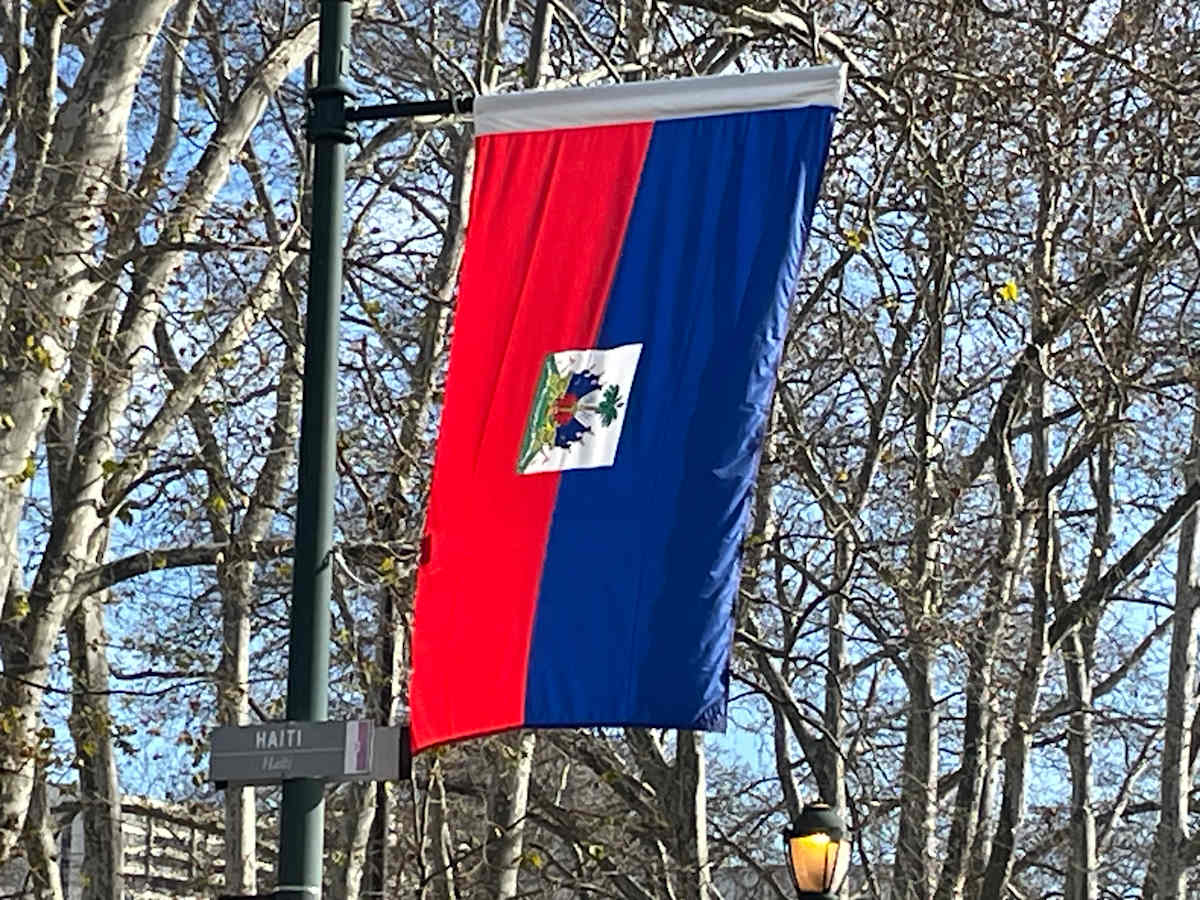
By MARLENE L. DAUT
May is Haitian Heritage Month, and to honor our culture, I usually like to keep it positive with celebrations of Haitian history. However, I saw something a few days ago that reminded me that at times keeping things positive and staying silent is actually not the best response, especially when it comes to those who insist upon demonizing Haitian history and culture. Staying silent and “turning the other cheek” is even less an option when such demonization comes from institutionalized authorities, rather than individual actors/trolls on the internet.
The latest case that caught my attention comes from the state of Florida, which on May 5, 2026, released new guidelines for teaching U.S. history in advanced high school courses. Called FACT, this course framework has been designed as a conservative challenge to the Advanced Placement (AP) courses used by most high schools. While I am gratified to see that the state of Florida’s so-called FACT curriculum includes the Haitian Revolution, since south Florida has one of the highest populations of Haitian immigrants and Haitian Americans in the United States, unfortunately, the framing of the Revolution in the new materials is not only incorrect but anti-Black and anti-Haitian.
Under the heading “Topic 7: The Founders and Slavery,” the proposed framework reads:
“Slavery Uprising in Santo Domingo: Between 1791 and 1804, a slave revolt in Haiti resulted in a race war, cruelty, and bloodshed. Over 100,000 whites and 60,000 blacks were killed. The violence caused American statesmen to realize that an imprudent or rash approach to resolving slavery could result in a similar race war and bloodshed in America.”
While the Haitian Revolution is here a mere add-on, examining the entire section shows that it is explicitly designed to paint the U.S. founders, and, in particular, Thomas Jefferson, as “anti-slavery,” which is as profound a distortion of history as is calling the Haitian Revolution an “uprising” and characterizing it as a “race war.” In reality (versus the delusional fantasy perpetuated by the creators of the FACT), the Haitian Revolution was not a mere “uprising,” it did not start or primarily occur in “Santo Domingo” (the eastern side of the island, today the Dominican Republic), and it was a struggle for freedom on the part of enslaved people, not a “race war.”
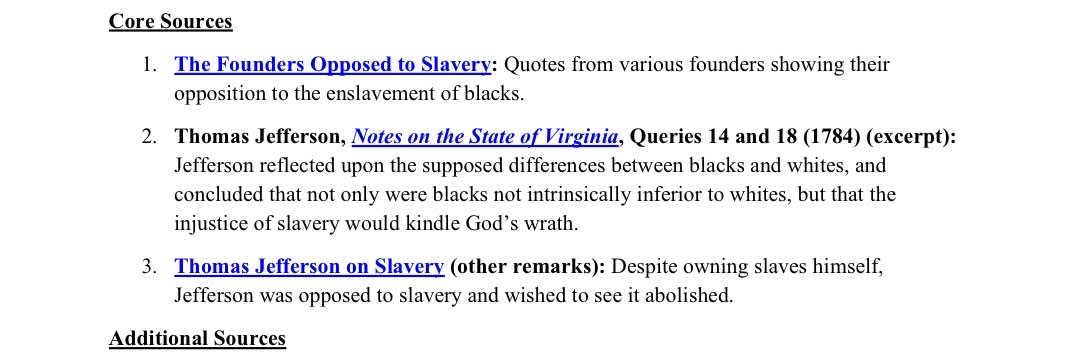
(Although the above excerpt from the FACT claims that Jefferson did not believe in the intrinsic inferiority of Black people, in his Notes on the Virginia, he said the exact opposite: "I advance it therefore as a suspicion only, that the blacks, whether originally a distinct race, or made distinct by time and circumstances, are inferior to the whites in the endowments both of body and mind [....] This unfortunate difference of color, and perhaps of faculty, is a powerful obstacle to the emancipation of these people.")
The Haitian Revolution refers to a collection of slave revolts and military strikes in the French colony of Saint-Domingue (the western side of the island of Hispaniola, today Haiti) from 1791-1804. Led by enslaved Africans and their descendants, who had lived under the torturous cruelty of the French colonists for nearly a century, the Haitian Revolution represents one of the world’s most significant armed struggles for freedom.
Beginning in August 1791, captive Africans whom the French had been kidnapping, enslaving, selling, raping, separating from their kin, and otherwise torturing and killing, began to set fire to the plantations of the white colonists who had perpetrated these crimes against them. Soon, enslaved Africans, including women and children, defected en masse from planting and harvesting the colony’s main crops of sugar, coffee, indigo, and cotton. In so doing, the Africans the French enslaved on the island effectively brought the brutal plantation economy to a standstill, and in the process, freed themselves from slavery, eventually, declaring their independence from France on January 1, 1804.
White French people killed Black people in far greater numbers throughout the Haitian Revolution (not to mention during the entire period of slavery). Yet it became common in the era, and remains so today, for onlookers, artists, journalists, historians, and other commentators to depict the Haitian Revolution as a time when Black people indiscriminately killed white people (often characterized as being driven by revenge rather than a desire for freedom). As I explained in my article, “All the Devils are Here,”
“Around 75,000 white French people died during the Haitian Revolution, a dramatic contrast to the more than 350,000 Black people who were killed. Yet it was rare in the nineteenth century to see any acknowledgment of this disparity. Portraying Black people as perpetrators of violence rather than its victims—a tendency that persists in many parts of the world to this day—functioned as a deliberate distraction from the everyday depredations of slavery and the atrocities that both the French colonists and the French army had committed in Saint-Domingue. The visual history of the Haitian Revolution can tell us a lot about how repeated exposure to representations of Black people in aggressive postures smothers histories of white violence and turns our gaze away from Black death. Because these images have become the default, they have directly contributed to the stereotype that Black rage is the source of societal violence rather than an aching response to it.”
The way we teach about Haiti and the Haitian Revolution in the United States is more important now than perhaps ever before precisely because U.S. politicians, led by the current president and vice president, as well as Elon Musk, have been reviving old stereotypes and inventing new ones to demonize Haiti, the first country to permanently abolish slavery. The speed of the internet helps these damaging narratives to travel and proliferate faster than anyone could possibly combat them and have led to material harms against the Haitian people. The discursive harms are no less consequential.
As I previously told a reporter from the Washington Post, attempts to demonize Haiti's origins in revolution have proved a fundamental and enduring way for political propagandists and apologist historians of the US founders to obfuscate the fact that while Jefferson continued to enslave people when he became president, "the Haitian revolutionaries did something the world had never seen by permanently abolishing slavery and creating a slavery-free state in the middle of all these other slaving empires.”
Having spent the majority of my adult life trying to educate the public about Haitian history—happily, the creators of the AP African American Studies exam consulted actual experts (including me) to create their guidelines for teaching about the Haitian Revolution—I am not going to sit back now and say nothing while the state of Florida tries to not only to rewrite and therefore silence the ingenuity of the Haitian Revolution, but to actively demonize it. The creators of the FACT seem intent on ensuring that a new generation (including Haitian Americans growing up in Florida!) will not see the Haitian Revolution as one of the most important freedom struggles the world has ever seen, but will come to view it instead, in the words of the FACT, as “[a] revolt and race war that ended with thousands dead on the island.” It bears repeating, the only people who ever engaged in “race war” on the island were white people, first, the Spanish, and then the French.
From “All the Devils are Here”:
“The torturous labor conditions in the colony [of Saint-Domingue] under French rule, which began in 1697, led to an extraordinarily high death rate for enslaved people in the eighteenth century. At least 500,000 enslaved Africans died from overwork and exploitation in French Saint-Domingue before the revolution even began. The nearly 900,000 captive Africans forcibly transported to the French side of the island lived an average of only three years afterward, while the life expectancy for those born in the colony was only fifteen years.”
In short, shame on the state of Florida for characterizing the Haitian Revolution as a “race war,” code words to describe a time when Black people putatively massacred whites, including pregnant women and innocent children, when, in fact, the exact opposite was the truth.
As usual, Haiti’s Baron de Vastey was both prescient and correct when, in 1814, he expressed outrage over the blatantly racist distortions proliferating in white European writing about slavery, colonalism, and the Haitian Revolution, concluding: “Posterity will never believe that in an age of Enlightenment, like ours, men who called themselves savants, philosophers, would have wanted to turn other men into animals, solely in order to conserve their atrocious privilege of being able to oppress another part of humankind.” Although Vastey laced this phrase with irony, its truths ring out more literally than he could have known.
Posterity does not believe that those “enlightened” men are the ones who tortured and killed enslaved people who dared to fight them for freedom, because the same kinds of propagandists now peddling Florida’s FACT US History guidelines have literally written the righteous story of Black resistance to slavery, along with the very words Haitian Revolution, out of the history curriculum.
How to cite this article: "On Not Staying Silent about Florida's Attempt to Silence Haitian History," King of Haiti's World Blog, May 14, 2026 <https://marlenedaut.com/blog/on-not-saying-silent-about-florida-s-attempt-to-silence-haitian-history>